Gold IRAs
Silver IRA: How It Works, What It Costs, and Who It Suits
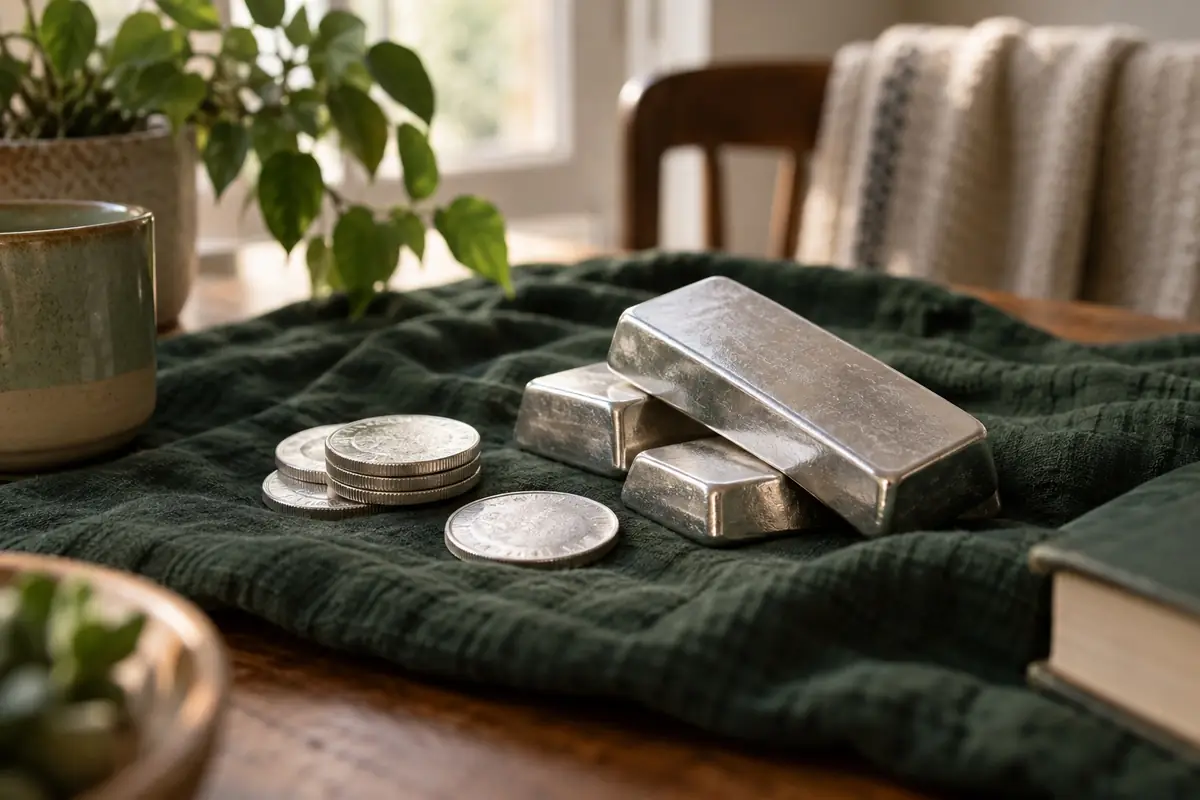
A silver IRA is a self-directed IRA that holds physical silver. The tax rules are the ordinary IRA ones. What changes is the metal: silver has to be .999 fine to qualify, it takes more vault space per dollar than gold, and its price follows industry as well as investors.
Free guide, plus a no-pressure call with a salaried Augusta educator who walks you through it. No obligation.
Before you open one
- A silver IRA runs on the same tax rules as any traditional or Roth IRA. Only the asset changes.
- Silver bullion has to be at least .999 fine to qualify, and most collectible coins don't make the cut.
- The custodian or an approved depository has to hold IRA silver. It can't live in your house.
- Silver takes far more room per dollar than gold, so ask how storage is priced before you open the account.
- More than half of U.S. silver use is industrial, so the business cycle moves its price along with investor demand.
What is a silver IRA, exactly?
It's an IRA. That's the first thing to get straight.
A silver IRA is an individual retirement account holding physical silver coins or bars instead, and the tax rules don't change because of what's inside. A traditional silver IRA follows traditional IRA rules; a Roth one follows Roth rules. Contribution limits, rollovers, withdrawals, and required minimum distributions work just as they would in any other IRA.
One account can hold gold, silver, platinum, and palladium side by side, if the custodian accepts them. People call it a "silver IRA" when silver is the main holding, and a precious metals IRA when they mean the account in general. If you want the shared basics, start with our guide on how a gold IRA works.
Why it has to be self-directed
Most banks and brokerage firms won't hold physical metal in their IRAs. You'll need a self-directed IRA with a custodian that accepts precious metals. The custodian holds the account and handles the paperwork. It doesn't pick your investments, and it won't advise you on them.
Who's involved, and how do they get paid?
| Party | What they do | How they're paid |
|---|---|---|
| Dealer | Sells you the silver, helps with paperwork, and will often buy it back later | The markup over the market price of silver |
| Custodian | Holds the IRA, keeps records, sends tax forms, reports to the IRS | Setup fees and yearly account fees |
| Depository | Stores and insures the silver in a secure vault | Yearly storage fees, billed through the custodian in many cases |
An IRA custodian has to be a bank, a federally insured credit union, a savings and loan association, or another entity the IRS has approved. Ask any custodian you're considering which one it is.
Which silver can go in?
Silver bullion that's at least .999 fine, or 99.9% pure, can go in. That figure comes from the tax code's exception for precious metal bullion, which borrows the futures exchange's delivery standard. Anything outside the exception counts as a collectible, and an IRA that buys a collectible is treated as having paid that money out to you.
The American Silver Eagle from the U.S. Mint qualifies, and the tax code names it. So do .999 bullion coins, bars and rounds from other mints and refiners, as long as your custodian accepts the product. Ask the custodian to confirm each one in writing. Our guide to IRA-approved coins and bars lists common products metal by metal.
What's out:
- Rare or older coins valued for their history or condition
- Most collectible, commemorative, or "limited edition" coins
- Sterling silver, which is about 92.5% pure, along with silver jewelry and tableware
The IRS lays out the rule on its page about collectibles in retirement accounts. And product type matters for cost too, which our guide to coins vs. bullion explains.
How does the money get in?
Three ways, the same as a gold IRA:
- A direct transfer from another IRA. One custodian sends the money to the other. You never touch it.
- A direct rollover from a 401(k). This one's usually from a former employer's plan, which sends the money straight to your new custodian.
- A new contribution. You're capped by the yearly limits on the IRS contribution limits page.
Ask for the money to go straight to the new custodian. A 401(k) check made out in your name generally means 20% withheld and a 60-day clock to deposit the full amount, including the part you never received. Our step-by-step rollover guide lays out each stage, and silver follows the same path.
Can I keep IRA silver at home?
IRA silver is kept at a depository. The bullion exception applies only while the metal is in the physical possession of the IRA's trustee. Take possession yourself and it's treated as a distribution. In a traditional IRA, that makes the value taxable income, and a 10% additional tax can apply if you're under 59½.
Want silver you can actually hold? Buy it with money outside your IRA. Our guide on buying physical metal outside an IRA covers that route.
What does a silver IRA cost?
The account fees are the same kind a gold IRA has. Two things differ with silver: storage and the dealer's premium are both larger relative to the metal's value, for reasons explained below. Knowing that lets you ask the right questions and compare quotes.
| Cost | How often | What it pays for, and what to ask |
|---|---|---|
| Setup fee | Once | Opening the account. Ask for the amount in writing |
| Custodian or admin fee | Yearly | Record-keeping and tax forms. Ask whether it's flat or scaled to the account's value |
| Storage and insurance | Yearly | An insured vault. Ask whether silver is priced by value, by weight, or at a flat rate |
| Dealer premium | Each purchase | Minting, shipping and the dealer's margin. Ask for it as a percent over spot for each product |
| Buyback spread | Each sale | The gap between spot and what the dealer pays you. Ask for the buyback price when you buy |
Why storage takes more room
Say you roll $50,000 out of an old 401(k) and put it all in silver. If an ounce of gold costs the same as 80 ounces of silver, your silver weighs about 80 times as much as $50,000 of gold would. That's a lot of shelf.
A depository's costs are space, handling, and insurance, and silver uses more of the first two. So a vault may price silver by weight or volume as well as value, or set a higher minimum. Ask how silver storage is priced, and get the yearly figure in dollars for the amount you plan to hold. Do it before you open the account.
Why the premium is a bigger percent
A one-ounce silver coin is worth far less than a one-ounce gold coin, yet it still has to be minted, shipped, and handled. Those costs are a bigger slice of a smaller price, so ask two or three dealers for written quotes on the same day and compare them.
Our gold IRA fee guide runs a full cost example. Plug in your own markup and storage numbers and the same math works for silver.
How does silver behave once you own it?
Silver is an industrial metal as well as a store of value. The U.S. Geological Survey estimates that in 2025, U.S. silver use was 25% electrical and electronics, 15% solar panels, and 19% other industrial uses and photography, with bars, coins and medals making up 32%. So the business cycle pushes on the price along with investor demand, and the price can move a lot in either direction.
Silver's return comes from its price. Our guide on gold vs. silver compares the two metals side by side.
Who is a silver IRA for?
A silver IRA suits you if you want physical silver held in a retirement account, you have money already in an IRA or an old 401(k), and you plan to hold it for years. The yearly fees are mostly fixed, so they're a smaller percent of a larger balance.
To open one you need money in an IRA or an old 401(k), and enough to meet the company's minimum. Each company sets its own, and the one we refer readers to asks for at least $50,000. How much goes into silver is your decision.
Required minimum distributions apply to traditional silver IRAs too. When they come due, you can sell some silver, take coins out of the account, or take the amount from another traditional IRA instead. Read our guides on required minimum distributions and who a gold IRA is for, and try the short quiz.
Common questions
Is a silver IRA a different account type from a gold IRA?
It's the same kind of account. Both are self-directed traditional or Roth IRAs, and the name just describes what the account mainly holds. One account can hold both metals.
Is the American Silver Eagle allowed in an IRA?
Yes. It's .999 fine silver from the U.S. Mint, and the tax code names it. Proof versions sell for more over their silver value than the bullion coin does, so compare prices before you pick one.
Can I take silver coins out of my IRA instead of cash?
Yes, if your custodian offers it; ask. It's called an in-kind distribution. In a traditional IRA, the silver's value on the day it leaves the account counts as taxable income. Our guide on selling gold or taking it out of an IRA has the details.
Where can I check the IRA rules for my situation?
Start with IRS Publication 590-A and Publication 590-B, which lay the rules out. For how they apply to your own case, a tax professional can help.
We base our guides on primary sources such as the IRS, the Department of Labor, and federal regulators. Read our editorial policy. Spot an error? Tell us.