Gold IRAs
Coins vs. Bullion: What You're Actually Buying
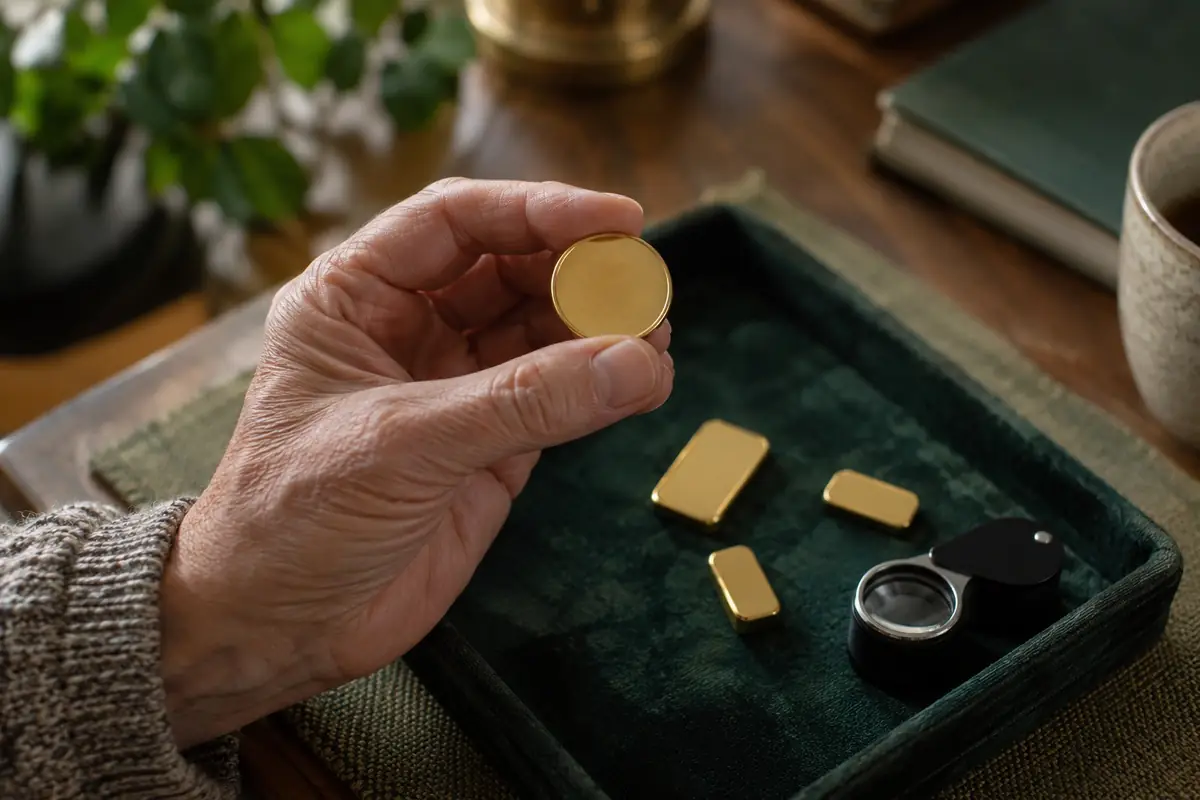
Two gold coins can hold the same amount of gold and cost wildly different amounts. The difference is the markup, it sets how far gold has to rise before you break even, and any dealer can tell you its size if you ask for it in writing.
Before you buy a single coin
- Spot is the market price of raw gold. Everything you can buy costs more than spot.
- Bullion coins and bars are priced mainly on their metal, and their markups are usually lower.
- Proof and "premium" coins cost extra for finish, packaging, or scarcity, and you might not get that extra back when you sell.
- The bigger the markup, the further gold has to rise before you break even.
- For every product, get the markup over spot and the buyback price in writing.
What is the spot price?
The spot price is what one troy ounce of raw gold sells for right now when it trades in large amounts. It moves all day, and financial news sites post the current number.
You won't pay it. Nobody buying a few coins does, because turning raw gold into coins or bars costs money and dealers need a profit. Every product sells for something above spot, and the difference is the premium or markup.
Bullion: gold priced as gold
Bullion is metal valued for its weight and purity. That's it. It comes in two main forms:
- Bullion bars: Plain bars stamped with weight, purity, and the refiner's name. They often carry the lowest markups, especially in bigger sizes.
- Bullion coins: Made in large numbers by national mints. Think American Gold Eagle, American Gold Buffalo, or Canadian Gold Maple Leaf. They usually cost a bit more than bars, but dealers everywhere recognize them, so they're easy to sell.
Bullion tracks spot closely, so if gold rises 10%, a bullion coin's value rises by about the same amount, and if gold falls, so does the coin, with no collector story propping it up.
What are proof and "premium" coins?
Some coins sell for well above their metal value. You'll hear them called proof coins, premium coins, numismatic coins, rare coins, or collectible coins; the terms overlap, and salespeople sometimes use them loosely.
Proof coins are struck more than once with specially polished dies, which gives them a mirror-like finish, and they're usually sold in protective cases with certificates that make the whole thing feel like an heirloom. Mints make fewer. They also cost more than the bullion version of the same coin.
Premium, rare, and collectible coins are priced on more than metal. A coin's age, condition, rarity, and grade go into the price, along with how badly collectors want it, which is how its value can drift away from the price of gold entirely. Gold can climb while a collectible coin loses value.
Why do premium coins carry higher markups?
Partly real costs. Partly what the market will bear.
- Higher production cost: Proof finishes, special packaging, and small runs cost more to make.
- Harder to price: Bullion has a clear market price. Collectible value is a judgment call, and that makes comparison shopping hard.
- Higher dealer margin: Murky pricing lets dealers earn more per sale on premium coins, which gives some salespeople a reason to push them.
On common bullion the markup tends to be a few percent over spot. On premium coins it can be many times that. Exact numbers differ by product and dealer, so ask.
What does the markup do to break-even?
Break-even is how far gold has to rise before you could sell and get back what you paid. Two things push it up. The markup going in. The spread coming out.
Say you've got $10,000 to spend, and gold's spot price doesn't budge. These numbers are made up to show the math:
| Bullion coin | Premium coin | |
|---|---|---|
| Markup when you buy | 4% over spot | 25% over spot |
| Gold value you get for $10,000 | About $9,615 | $8,000 |
| Buyback price when you sell | 1% under spot | At about spot |
| What you get back if gold is flat | About $9,520 | About $8,000 |
| Rise in gold needed to break even | About 5% | About 25% |
Both coins hold gold. What changes is how much of your $10,000, a big slice or a small one, actually turned into gold and how much went to the dealer. With the premium coin, gold has to rise about five times as far before you're whole. Yearly IRA fees push both break-even points higher still, and our guide to gold IRA fees shows how those stack up.
Could a premium coin sell for more than its metal if collectors stay keen? Sometimes. We wouldn't count on it, and it's hard to judge ahead of time.
Which products can go in an IRA?
That's a separate question from cost. Collectibles aren't allowed. Buy one with IRA money and the IRS treats it as a distribution, which can mean taxes and possibly penalties.
Precious metals get in if they meet IRS standards:
- Gold bullion must be at least .995 fine.
- Silver bullion must be at least .999 fine.
- Platinum and palladium bullion must be at least .9995 fine.
- Certain U.S. Mint coins named in the tax code are allowed, including the American Gold Eagle, even though it's 22 karat gold.
Rare and collectible coins valued for scarcity or condition don't qualify. Some proof versions of eligible coins are accepted by IRA custodians, but the rules on specific products get detailed fast, so before any money changes hands, have your custodian confirm the product is IRA-eligible. Our guide on how a gold IRA works covers the rules in more depth.
How to get the spread in writing
Before you buy, ask the dealer for a written quote on each product. Email's fine. It should list:
- The product's exact name, year if relevant, weight, and purity
- The quantity and the price per coin or bar
- The spot price of the metal at the time of the quote
- The markup over spot, as a dollar amount and a percentage
- What the dealer would pay to buy the same product back from you today
- Confirmation from the custodian that the product is IRA-eligible
Item 5 is the big one. The gap between today's selling price and today's buyback price is your real round-trip cost, and a dealer who won't give you a buyback quote leaves you no way to judge what you're paying.
Shop around. Ask two or three dealers to price the same common bullion coin and you'll quickly see what a reasonable markup looks like. Our guide on choosing a gold IRA company has more questions.
Which should you choose?
Picture this one. A salesperson calls back after your first conversation and says the bullion coins you asked about are "ordinary," and that a limited-mintage proof coin would be a smarter fit for your IRA. Ask for both quotes, markup over spot and buyback price, side by side. Then read them. The numbers will tell you more than the pitch.
In our view, if the goal is to own gold as part of a retirement plan, common bullion coins and bars do the job at the lowest cost and they're the easiest to sell later. Premium coins add cost plus a second risk: that collector demand fades.
Collecting coins as a hobby is a different goal. Do that with money outside an IRA, where the IRS rules on collectibles don't limit your choices.
Still deciding whether gold belongs in your retirement plan at all? Our short quiz can help you think it through.
Common questions
Is a gold coin better than a gold bar?
Neither wins every time. Bars often carry lower markups, especially in larger sizes, while popular bullion coins are widely recognized and easy to sell in small amounts. We'd get the markup and buyback price on both before choosing.
Why is the American Gold Eagle allowed if it is only 22 karat?
The tax code specifically lists certain U.S. Mint coins as permitted in IRAs. The Gold Eagle is one of them, so it qualifies even though its purity is below the .995 standard for bullion.
Are proof coins a bad choice?
Not always, but they cost more than bullion versions of the same coin. Get the markup over spot and the buyback price so you can see how much extra you're paying and if you're likely to get it back.
What should I do if I already bought premium coins?
Ask your dealer for a current buyback quote so you know where you stand. You might decide to hold them. If you're unsure, a fee-only financial planner can help you look at your options. And next time you get a quote, check the spot price at that same moment so you can see the markup yourself.
We base our guides on primary sources such as the IRS, the Department of Labor, and federal regulators. Read our editorial policy. Spot an error? Tell us.