Withdrawals
How to Sell Gold or Take It Out of an IRA
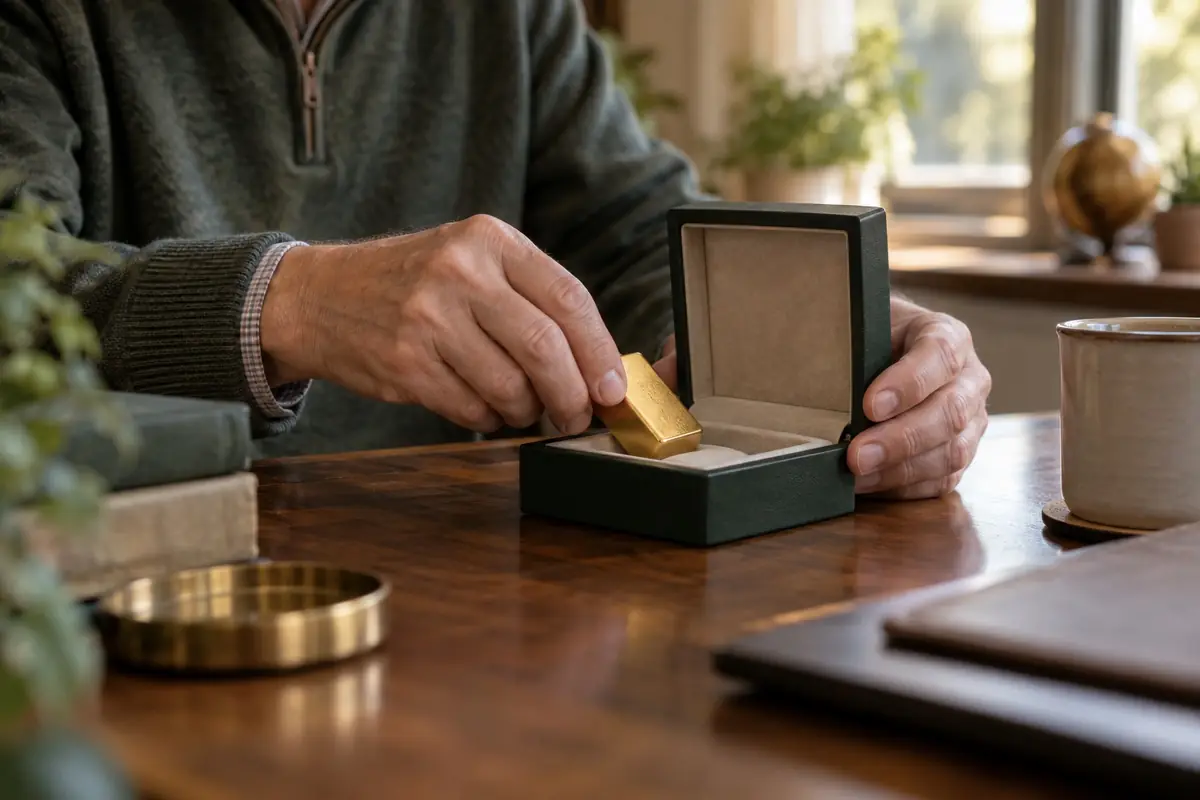
Getting cash or coins out of a gold IRA takes more steps than selling a fund. You can sell the metal inside the account or take the coins themselves, and each choice costs and gets taxed differently. Required minimum distributions add a wrinkle when the account holds metal instead of cash.
What to know before you sell
- A sale inside your IRA isn't taxed on its own. Tax kicks in when money or metal leaves a traditional IRA and isn't rolled over.
- Buyers usually pay less than the market price, so get the buyback price before you agree to anything.
- You can take the coins or bars out as an "in-kind" distribution. From a traditional IRA, their value counts as income.
- Traditional gold IRAs have required minimum distributions, and you can meet them with cash, metal, or both.
- Roth gold IRAs have no RMDs for the original owner, and qualified withdrawals are tax-free.
Sell it, or take it home?
Two choices. You can sell the metal inside the IRA, so the cash lands in the account and you can leave it, reinvest it, or withdraw it. Or you can take the metal out, and the custodian ships the coins or bars to you. That second route is called an in-kind distribution.
Plenty of people do some of each over the years. Which one fits depends on whether you need cash, want to own the metal personally, or just have to meet a required distribution.
| Action | Traditional gold IRA | Roth gold IRA |
|---|---|---|
| Sell metal, keep cash in IRA | Not taxed | Not taxed |
| Withdraw cash | Generally taxed as income | Tax-free if qualified |
| Take metal in kind | Value generally taxed as income | Tax-free if qualified |
| Required minimum distributions | Yes | No, for the original owner |
Selling metal inside the IRA
The cash from a sale stays in the account, and the sale itself isn't a taxable event. Tax only shows up if you then pull that cash out of a traditional IRA, or take a non-qualified withdrawal from a Roth.
Selling back to the dealer
Most people sell to whoever sold them the metal, since a lot of dealers run buyback programs. It goes like this:
- You call the dealer and ask for a buyback quote.
- If you like the number, you lock the price, normally over the phone.
- You or the dealer tell the custodian, and the custodian signs off on the sale.
- The depository releases the metal to the dealer.
- The dealer pays your IRA, and the cash shows up in your account.
Selling to someone else
You usually don't have to sell back to the original dealer. Other precious metals dealers buy too, and a second quote is the easiest way to tell whether the first one is fair.
The sale still runs through your custodian. The depository ships the metal to the buyer, the buyer pays your IRA, and nothing ever touches your hands. Some custodians only work with certain buyers. Ask first.
What the buyback spread costs you
Buyers almost always pay less than spot, the current market price of the metal. That gap is the buyback spread. On common bullion coins and bars it's often small. On proof and premium coins it can be brutal, because buyers often pay close to the metal's value and ignore the extra premium you paid, so you can get back far less than you spent even after gold has gone up.
Before you sell, ask for three numbers: the buyback price per coin or bar, the spot price at that moment, and any fee the custodian charges for the sale. Our guide to coins vs. bullion explains why premium coins often lose more on resale.
How long does it take?
It depends on the dealer and custodian. The price lock usually happens the same day. Getting the metal released and the cash credited to your IRA often takes about a week or two, and if you're withdrawing the cash, add a few business days for the custodian to send it to your bank. Need money by a certain date? Start early.
Taking the metal out
With an in-kind distribution, the custodian sends you the actual coins or bars, and once they're in your hands they belong to you personally and aren't part of the IRA anymore, for tax purposes or any other. Simple enough.
The tax bill from a traditional IRA
The metal's fair market value on the distribution date counts as ordinary income for that year, and the custodian reports it on Form 1099-R. Say the custodian values your coins at $12,000 on that date. You report $12,000 of income. No cash, still taxed.
If you're under 59½, a 10% additional tax applies too, unless you qualify for an exception. IRS Publication 590-B lists them.
That leaves a practical problem: you owe tax but received no cash to pay it with, and there's nothing in the distribution to withhold from. Ask your custodian how it handles withholding on in-kind distributions, and set the tax money aside before the coins arrive.
After the metal is yours
From here on, a sale falls under the rules for personal property. Gains on gold you've held personally for more than a year are taxed under the collectibles rules, which can mean a higher rate than you'd pay on stocks, so talk with a tax professional about your cost basis and holding period before you sell. You'll also have to store and insure the metal yourself and cover shipping, which custodians and depositories often charge for.
RMDs when your IRA holds gold
A traditional gold IRA has required minimum distributions (RMDs) like any traditional IRA. Under current law they start at age 73 if you were born from 1951 through 1959, and at age 75 if you were born in 1960 or later. Confirm your own start age on IRS.gov.
The amount comes from your account balance at the end of the prior year and an IRS life expectancy table. Our RMD calculator will estimate it, and our guide to required minimum distributions covers the rules.
Three ways to cover it
- Sell metal and withdraw cash. Sell enough inside the IRA to cover the RMD, then take the cash.
- Take metal in kind. Coins or bars worth at least the RMD amount get shipped to you. Their value counts toward the RMD and is taxed as income.
- Use another IRA. If you own more than one traditional IRA, you can add up the RMDs and take the total from any one or more of them. That doesn't work for 401(k) plans, which each need their own RMD.
We'd look at that last one first. Picture yourself at 75 with a gold IRA and a regular brokerage IRA, both traditional. You add the two RMDs together and take the whole amount from the brokerage IRA, so the gold stays put and you never have to sell a single coin to beat a year-end deadline. Easy.
Some people also park a little cash in the gold IRA to cover fees and RMDs, which spares them from having to sell metal on short notice at whatever price the buyer happens to offer that week. Smart move.
Roth gold IRAs play by different rules
- No RMDs for you. The original owner of a Roth IRA never has to take required minimum distributions, so the metal can sit as long as you like. Beneficiaries who inherit a Roth have their own rules.
- Qualified withdrawals are tax-free. A withdrawal generally qualifies if you're 59½ or older and your first Roth IRA contribution was made at least five years ago. Cash or metal, it comes out tax-free.
- Non-qualified withdrawals can cost you. Miss those conditions and part of the withdrawal can be taxable, possibly with a 10% additional tax on top. Your own contributions come out first, and those aren't taxed.
The five-year rule has exceptions and wrinkles. Check IRS Publication 590-B or ask a tax professional before any Roth withdrawal.
Your checklist before you sell or withdraw
- Decide whether you need cash, metal, or both.
- Get a written buyback quote from your dealer and at least one other buyer.
- Ask your custodian about fees, timing, and tax withholding.
- For an in-kind distribution, ask how the metal will be valued and what shipping costs.
- Run the withdrawal past a tax professional so it fits your tax picture for the year.
- Leave extra time near year-end if you're meeting an RMD.
If you haven't opened a gold IRA yet, weigh these exit costs alongside the gold IRA fees you'd pay going in. We also cover when a gold IRA is not a good fit.
Common questions
Do I have to sell back to the company I bought from?
Usually not. You can get quotes from other dealers. The sale still goes through your custodian, so check how it handles outside buyers.
Will I get a tax form when I take metal out?
Yes. Your custodian sends Form 1099-R showing the value of the distribution. File it with your tax records.
Can I put the metal back into an IRA later?
Possibly, but don't plan on it. In some cases distributed property can be rolled over within 60 days. Limits apply and the rules are strict, so talk with your custodian and a tax professional before you count on it.
What happens to my gold IRA when I die?
It goes to your named beneficiaries. They'll have their own rules for taking distributions. Keep your beneficiary forms current with your custodian.
We base our guides on primary sources such as the IRS, the Department of Labor, and federal regulators. Read our editorial policy. Spot an error? Tell us.