Gold IRAs
Segregated vs. Commingled Storage for a Gold IRA: What You Pay For
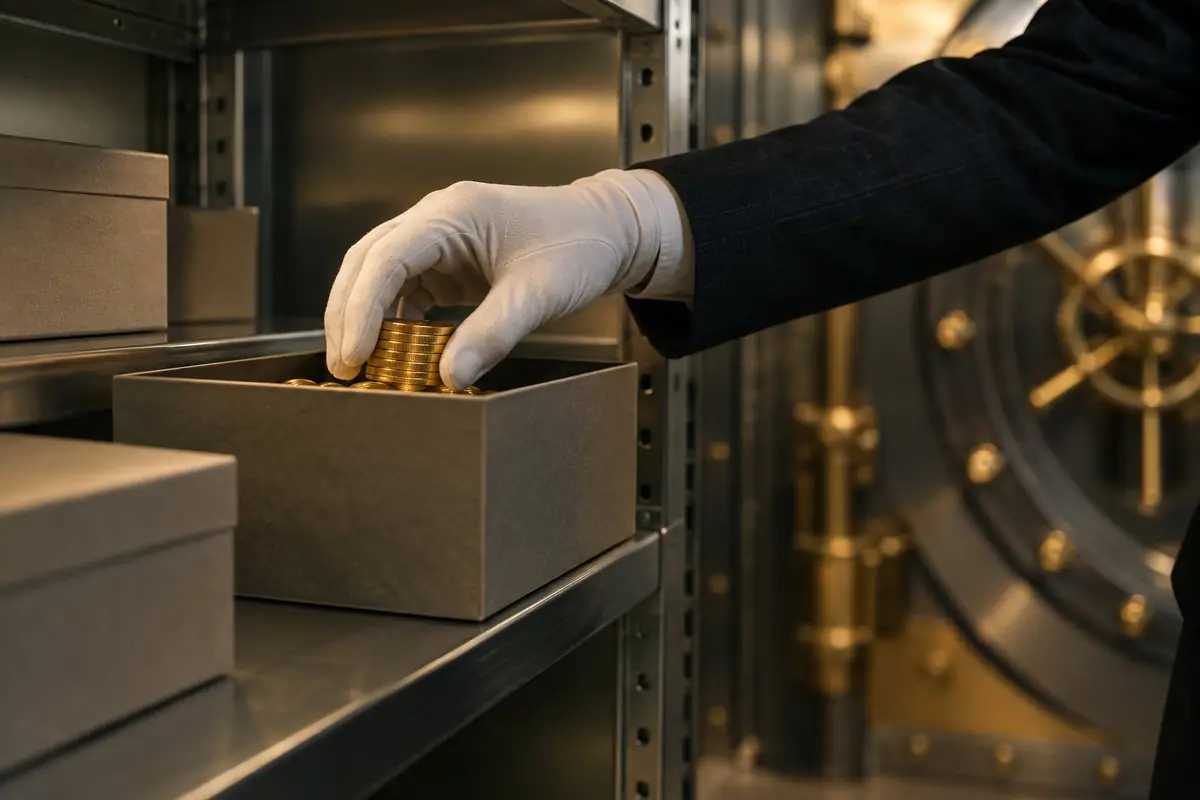
When you open a gold IRA, someone will ask whether you want segregated or commingled storage. It's an easy decision once you know the terms, and the questions about insurance, audits, and how the fee is calculated matter just as much. Here's what the two words mean and what the difference costs over twenty years.
What to know first
- Segregated storage keeps your exact coins and bars apart from everyone else's. Commingled storage pools them with identical metal owned by other customers.
- Either way, the metal belongs to your IRA and shows up on your custodian's statement.
- Segregated storage costs more: $50 to $100 a year more on the three flat-fee schedules we read in October 2026.
- A flat fee or a percentage of value can matter more than the storage type. A percentage fee grows when gold's price does.
- IRA metal is stored at a depository, not at home. The U.S. Tax Court ruled against an owner who kept hers in a home safe.
What do the terms mean?
A depository is a company that runs high-security vaults. Your IRA custodian has an account there, and your metal is held under it for the benefit of your IRA. The storage type describes how the metal sits on the shelf. Our guide to who does what among the custodian, dealer, and depository has more on that arrangement.
Segregated
Your coins and bars go into their own container or space, labeled to your account, apart from every other customer's metal. If you later take the metal out of the IRA, you get the same pieces that went in. The same bars with the same serial numbers, the same coins from the same years.
Commingled, or non-segregated
Your metal is stored together with matching metal that belongs to other customers. You own a specific quantity of a specific product: twenty one-ounce American Gold Eagles, say. When you take delivery you get twenty one-ounce American Gold Eagles. They may not be the twenty you sent in. "Non-segregated" means the same thing, and it's the term you'll see on many fee schedules.
For plain bullion this makes little practical difference, because one standard coin is worth what the next one is. It matters more if you own something where the individual piece counts, such as a bar you want back by serial number. Gold bars vs. gold coins explains serial numbers and assay cards.
Allocated and unallocated
These two words answer a different question, and it's the more important one.
Allocated means specific physical metal is set aside and titled to you. It isn't the depository's property, and the company has no right to use it. Both segregated and commingled IRA storage should be allocated. Some depositories use "allocated" to mean segregated, so ask what the word means at that company.
Unallocated means you hold a claim on a pool of metal and no title to particular pieces. You're closer to a creditor of the company than the owner of coins. Pooled and unallocated accounts are sold outside IRAs. If anyone offers that kind of account for IRA metal, ask your custodian in writing how it satisfies the rule that the trustee keeps physical possession of the bullion.
What's the usual price difference?
Custodians publish their own fee schedules, and they aren't alike. We read three with flat storage prices in October 2026. Commingled storage was $110, $115 and $125 a year, and segregated was $160, $175 and $225, so the step up cost $50 to $100 a year. On one schedule the $225 is a minimum that rises with the metal's value on accounts above $125,000. Prices change, so get the current number from the custodian you're considering.
Three things change the bill more than people expect:
- Flat or percentage. Some schedules charge a flat dollar amount. Others charge a percentage of the metal's value, or switch to a percentage above a certain account size. One custodian's schedule we read charges 0.20% of the account's value a year.
- Minimums. A percentage schedule can carry a minimum yearly charge, and that minimum is what a small account ends up paying. On the 0.20% schedule it's $150.
- What's bundled. Ask whether insurance is included in the storage fee. The custodian's own yearly fee is a separate line on the schedules we read. Check both.
Our gold IRA fee guide covers the custodian fee, the dealer's markup, and the rest.
A 20-year comparison
Say your IRA holds $100,000 of gold and you leave it there for twenty years. The fee levels below are made up to show the math. Yours will differ.
| Storage fee | Per year | Over 20 years |
|---|---|---|
| Commingled, flat $150 | $150 | $3,000 |
| Segregated, flat $250 | $250 | $5,000 |
| 0.5% of value, metal stays at $100,000 | $500 | $10,000 |
| 0.5% of value, metal worth $200,000 from year 11 on | $500, then $1,000 | $15,000 |
Look at the first two rows. Choosing segregated over commingled costs $100 a year in this example, or $2,000 across two decades. On a $100,000 account that's two percent of the starting balance, spread over twenty years. A modest price, if having your own pieces matters to you.
Now the last two rows. The jump from a flat fee to a percentage fee costs far more than the jump from commingled to segregated, and the percentage bill keeps climbing if gold does. Nobody knows what gold will be worth in ten years, and we're not guessing. The table shows only how the two fee types behave.
It cuts the other way for small accounts. On $20,000 of metal, 0.5% is $100 a year, less than either flat fee above, unless a minimum charge applies. So the first question is "flat or percentage, and is there a minimum?" Only after that does "segregated or commingled?" matter much.
Each year's bill is paid from cash in the account or directly by you. Keep a little cash in the IRA or pay the fee yourself; otherwise the custodian's agreement may let it sell some metal to settle the bill.
You can plug your own figures into our gold IRA cost calculator.
So which one should you pick?
For standard bullion coins and bars, we think commingled storage at a well-run depository is a reasonable choice, and it's the cheaper one. You get back the same product in the same quantity.
Segregated is worth the extra if you want your own pieces back, if you hold large bars where serial numbers matter to you, or if knowing your metal sits in its own labeled box is worth the extra to you. That last reason is a fair one. It's your money.
Both are sound choices at an insured, audited depository, where your IRA owns its metal either way. If a salesperson tells you commingled storage is unsafe, ask what that's based on.
Insurance and audit questions for any depository
You can ask these of the custodian, the dealer, or the depository itself. Get the answers by email.
- Which depository will hold my metal, and at which location?
- Is my metal segregated or commingled, and is it allocated to my IRA in either case?
- Who insures it? Is coverage for the full market value, and what's excluded?
- Is the insurance the depository's own policy, and can I see a certificate or summary?
- Who audits the vault, how often, and is the auditor independent of the depository?
- Does the custodian reconcile its records against the depository's count? How often?
- Can the depository, custodian, or dealer ever lend, lease, or pledge my metal?
- Is the storage fee flat or a percentage? Is there a minimum, and does it change with account size?
- What do deposits, withdrawals, and shipping cost?
- What will my statement list: product, quantity, weight, and for bars, serial numbers?
- Can I change depositories or storage type later, and what does that cost?
- If the depository or the custodian failed, what happens to my metal?
Then check the statement. It should come from the custodian, and it should list what you own. A summary from the dealer isn't the same thing. The CFTC has warned that fraudulent dealers have charged storage and insurance fees for metal that never existed, and its advisory on buying physical metals covers what to ask about a gold IRA. Our guide to checking a gold IRA company's background shows how to look up the custodian and depository separately from the dealer.
Why can't you store IRA gold at home?
Because the tax break depends on someone else holding it. The tax code treats precious metals as collectibles, which IRAs can't own, and then makes an exception. The IRS describes that exception as covering bullion of a certain fineness if a bank or approved non-bank trustee keeps physical possession of it. Our self-directed IRA guide covers the collectibles rule and the metals exception.
Some promoters have sold a workaround. Your IRA would own a limited liability company, you'd manage the LLC, the LLC would buy coins, and you'd keep the coins in your own safe.
The U.S. Tax Court took up that arrangement in McNulty v. Commissioner, decided in November 2021. The taxpayer's IRA owned an LLC that she managed. The LLC bought American Eagle coins with IRA money, and the coins were shipped to her home and kept in a safe. The court held that she had received taxable distributions from her IRA when she took possession of the coins. It reasoned that an IRA owner can't have unfettered command over IRA assets without tax consequences. The court also upheld accuracy-related penalties.
If you want gold you can hold, buy it outside the IRA with other money. We compare the two in gold IRA vs. physical gold, and storing physical gold covers safes, bank boxes, and private vaults for metal you own outright.
Common questions
Is commingled storage safe?
At an insured, audited depository, your IRA owns a set quantity of a specific product and the custodian's statement shows it. The difference from segregated is that you don't get the identical pieces back.
How much more does segregated storage cost?
On the three flat-fee schedules we read in October 2026, $50 to $100 a year more than commingled. Prices differ by depository and custodian, so ask for the current fee schedule.
Can I visit the depository and see my gold?
Policies differ. Some depositories allow visits by appointment and others don't, so ask before you open the account if it matters to you.
Can I switch from commingled to segregated later?
Ask your custodian. Where it's allowed there may be a fee, and the metal may have to be re-counted or moved.
Is the storage fee the only yearly fee?
There's one more. The custodian charges its own yearly fee for holding the account and reporting to the IRS. Add the two together when you compare companies.
Can I keep gold IRA coins in a bank safe deposit box?
The metal has to stay in the custody of the IRA's trustee or custodian, which in practice means the depository it uses. A box you rent yourself doesn't count.
We base our guides on primary sources such as the IRS, the Department of Labor, and federal regulators. Read our editorial policy. Spot an error? Tell us.