Physical gold & silver
Gold Bars vs. Gold Coins: Premiums, Storage, and Resale
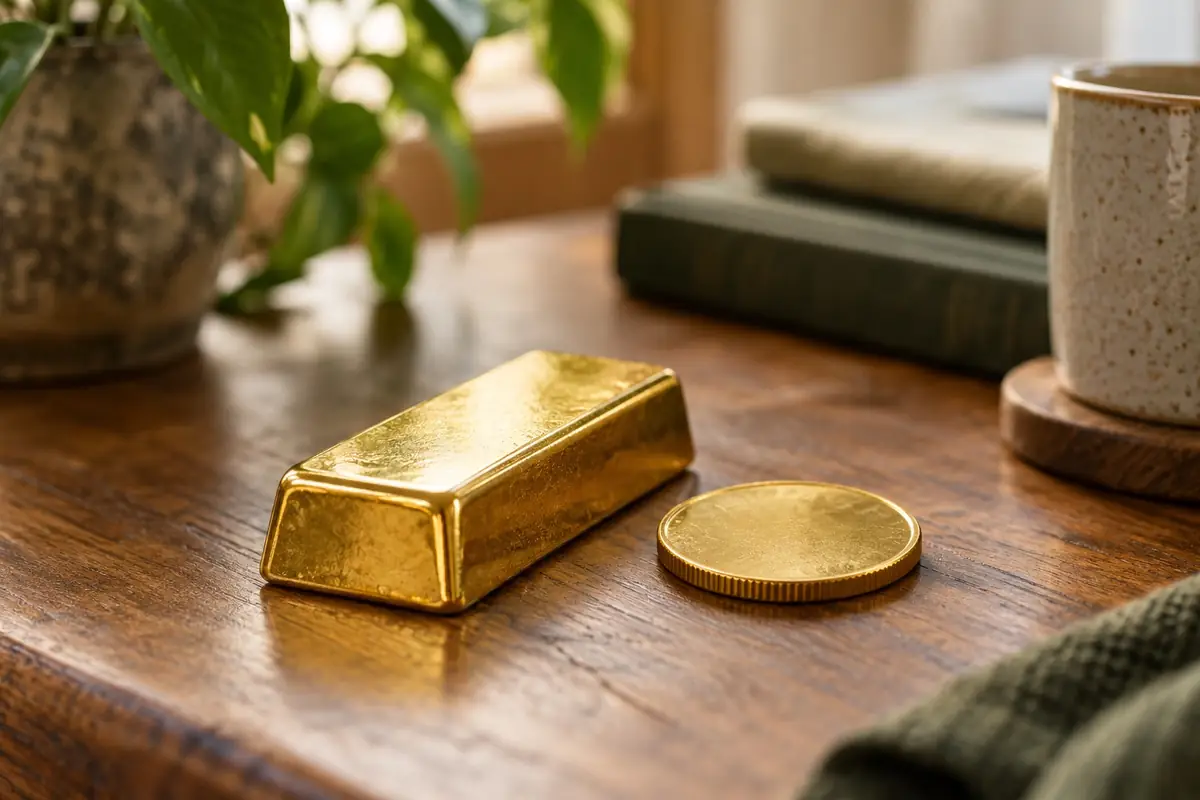
Bars and bullion coins both put real gold in your hands. They don't cost the same, though, and they don't sell the same. And with either one, where you buy matters more than what you buy.
What to know before you pick
- Government mints make bullion coins, while private refiners make most bars.
- Bigger bars usually cost less per ounce, while small bars and fractional coins usually cost more.
- Buyers recognize well-known coins on sight, which makes them easier to sell a few at a time.
- Both can go in an IRA if they meet IRS rules, but some popular coins don't qualify.
- Fakes exist in both forms. Your best defense is buying from an established dealer.
Coin or bar: what's the actual difference?
A bullion coin comes from a national government mint. It carries a face value in that country's currency and it's legal tender, though the face value is a tiny fraction of the gold inside. Nobody spends one, though; you buy it for the gold.
A gold bar usually comes from a private refiner. It's stamped with its weight, its purity, and the refiner's name or logo, and it has no face value at all. Its price rests on the gold in it and the name on it, and nothing else.
We're comparing bullion coins with bars here. Proof and "premium" collectible coins are priced on a different basis entirely, and our guide to coins vs. bullion covers them.
Coins you'll run into
- American Gold Eagle and American Gold Buffalo, from the U.S. Mint
- Canadian Gold Maple Leaf, from the Royal Canadian Mint
- Britannia, from the Royal Mint in the United Kingdom
- Vienna Philharmonic, from the Austrian Mint
- Krugerrand, a South African coin
Most of them come in a 1 ounce size plus fractional sizes like 1/2, 1/4, and 1/10 ounce.
Bar sizes
For individual buyers, bars run anywhere between 1 gram and 1 kilogram (about 32 troy ounces). The giant bars of around 400 ounces trade between banks and central banks; you won't see one at a coin shop, and you wouldn't want to carry it out. Among personal buyers, the 1 ounce and 10 ounce sizes are the ones you'll see most.
Why do small pieces cost more per ounce?
Every coin and bar sells above the spot price, the market price of raw gold. The gap is the premium, and it pays for making, shipping, and selling the piece, plus the dealer's profit.
The catch is fixed costs. Making a piece costs about the same whether it's small or large, so on a small piece that cost gets spread over less gold and the premium per ounce climbs. If you only learn one pricing rule, make it this one.
The table shows the shape of it. We made up the percentages to illustrate; real premiums move with demand and differ from dealer to dealer.
| Product | Example premium over spot | What it means |
|---|---|---|
| 1 kilogram bar | About 1% to 2% | Lowest cost per ounce, but a large single purchase |
| 10 oz bar | About 2% to 3% | Low cost per ounce, still a big unit to sell |
| 1 oz bar | About 3% to 5% | Flexible size at a slightly higher cost per ounce |
| 1 oz bullion coin | About 4% to 7% | Costs more, but dealers everywhere recognize it on sight |
| 1/10 oz bullion coin | About 8% to 15% or more | Handy for selling one at a time, but pricey per ounce |
Two patterns hold in almost every market. Bars cost less per ounce than coins of the same weight, and fractional coins cost noticeably more per ounce than 1 ounce coins, which is the same fixed-cost math showing up twice.
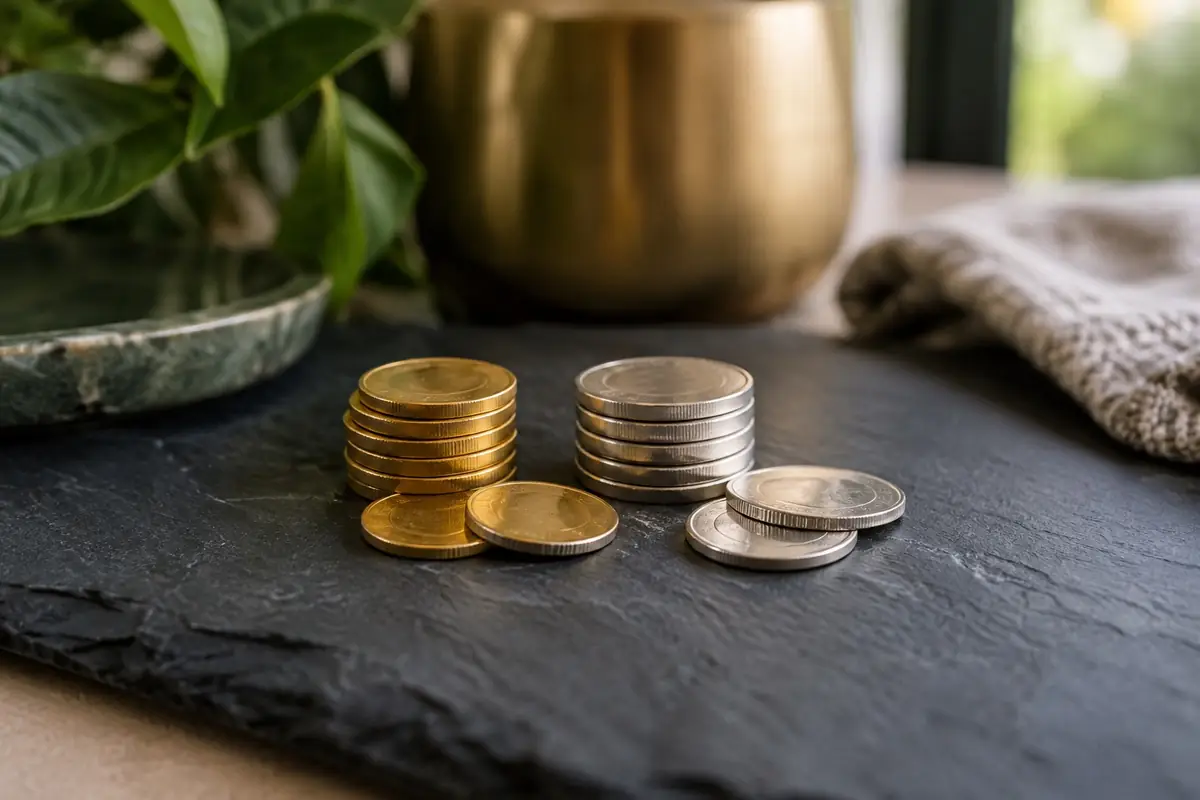
Suppose you're at the counter choosing between ten 1/10 ounce coins and a single 1 ounce coin. It's the same amount of gold, but at most dealers you'll pay more for the ten.
Which one's easier to sell?
Whoever buys your gold has to trust it's real and that it's what the stamp says. That's where coins and bars part ways.
Coins: recognized on sight
Government bullion coins are struck to exact, published specs. Dealers handle them every day and know their size, weight, and design cold, and many modern coins add security features like fine micro-engraving. Buyers can check them quickly, and they rarely turn one down.
Coins also let you sell in small bites: if you need a little cash, you can sell one coin and keep the rest.
Bars: it comes down to the brand
Bars from well-known refiners find buyers without much trouble. A bar from a maker nobody's heard of can draw a lower offer, or the buyer may insist on testing it before paying. Big bars have another drawback, too, since you can't sell half of a 10 ounce bar.
Then there's the buyback spread: the gap between what a dealer charges to sell you something and what it'll pay to buy the same thing back. On common products from known mints and refiners the spread is often small, but you should still get both prices before you buy so you know your full round-trip cost.
What are assay cards and serial numbers?
Lots of smaller bars, especially 1 ounce and under, come sealed in a plastic card called an assay card. It shows the bar's weight and purity, and in many cases a serial number that matches one stamped on the bar itself.
Plenty of larger bars carry serial numbers too. They help you keep clean records and help a buyer confirm what you've got when it's time to sell. Most bullion coins don't carry them.
- Leave sealed cards sealed. Some buyers pay less for a bar that's been taken out of its original packaging.
- Hang on to your receipts. They show what you paid, and you'll need that number for taxes when you sell.
- Don't treat a card and serial number as proof. They make a bar easier to sell, but counterfeiters copy packaging too.
Which ones are allowed in an IRA?
If the gold's headed for a self-directed IRA, it has to meet IRS rules. The tax code sets gold bullion at .995 fine or better, and the IRA's trustee or custodian has to keep physical possession of it. The law also names certain U.S. Mint coins outright, including the American Gold Eagle, even though it's 22 karat gold. The IRS sums up these exceptions on its page about collectibles in retirement accounts.
- Bars: Most bars from established refiners are .999 or .9999 fine. Many custodians accept bars only from refiners on recognized industry approval lists, so check first.
- Coins that qualify: American Gold Eagles and Buffaloes, Canadian Gold Maple Leafs, plus any other bullion coin that meets the purity standard.
- Coins that don't: the Krugerrand. It's 22 karat gold, below .995 fine, and it isn't one of the U.S. coins named in the law, so custodians won't take it.
Product-level rules get detailed, so have your IRA custodian confirm a product is eligible before you spend a dollar. Our guide on how a gold IRA works has the full rules, and the silver IRA guide handles silver.
Do they store differently?
Not in any way that matters much. Bars stack neatly and take a bit less room for the same gold, and coins sit compactly in tubes or small boxes. The real question is where either one lives: a home safe, a bank safe deposit box, or a private depository, each with its own trade-offs on cost, access, and insurance. Our guide to storing physical gold and silver goes through all three.
How do you avoid buying a fake?
Counterfeit bars and coins are out there. Some are plated base metal, while others hide a heavy metal like tungsten under a thin skin of gold so the weight checks out. Nobody knows how many are in circulation, but dealers take the risk seriously, and so should you.
Where you buy matters much more than what you buy.
- Stick with established dealers. You want a dealer that's been around a long time and has a physical address. Its policies should be in writing, and clear. Before you send any money, check for complaints with your state attorney general or consumer protection office.
- Distrust prices below spot. Real dealers almost never sell gold for less than its metal value. If the deal looks too good, it probably is.
- Go carefully with online marketplaces and private sellers. You can't always verify who's on the other end, and you can't always send a fake back.
- Favor products everyone knows. Common coins and bars from big-name refiners are well documented, so fakes stand out.
- Keep receipts and packaging. A clean purchase history makes resale smoother.
Many dealers who buy gold test it with tools that read a metal's makeup or density without damaging it. Unsure about a piece you already own? A reputable dealer can check it for you.
So which should you buy?
It depends on what you care about most.
| If you care most about | Lean toward |
|---|---|
| The lowest cost per ounce | Larger bars from well-known refiners, which carry the lowest premiums |
| Selling small amounts over time | 1 oz bullion coins or small bars you can sell one at a time |
| Quick recognition by any buyer | Government bullion coins |
| Holding gold in an IRA | Products your custodian confirms are eligible before you buy |
Plenty of buyers split the difference, holding a few larger bars to keep costs down and some 1 ounce coins for flexibility. That's a sensible mix, in our view. Buying outside a retirement account? Our guide to buying physical gold outside an IRA covers pricing, payment, and taxes. If you're still deciding whether gold belongs in your plan at all, the short quiz can help.
Common questions
Are gold bars cheaper than gold coins?
Per ounce, usually, since bars tend to carry lower premiums than coins of the same weight, and the biggest bars carry the lowest of all. Get written quotes on the same day to see the real gap.
Does a serial number prove a bar is real?
No. A serial number and assay card help with records and resale, but counterfeiters copy them. An established dealer is the better safeguard.
Can I put Krugerrands in a gold IRA?
No. The Krugerrand falls short of the .995 purity standard and isn't one of the U.S. coins the tax code allows. Have your custodian confirm any product before you buy.
Should I open the plastic around my bar?
We wouldn't. Some buyers offer less for a bar that's been pulled from its original assay card.
We base our guides on primary sources such as the IRS, the Department of Labor, and federal regulators. Read our editorial policy. Spot an error? Tell us.